






Possible new dwarf planet discovered beyond Pluto — and it could be one of the largest ever found

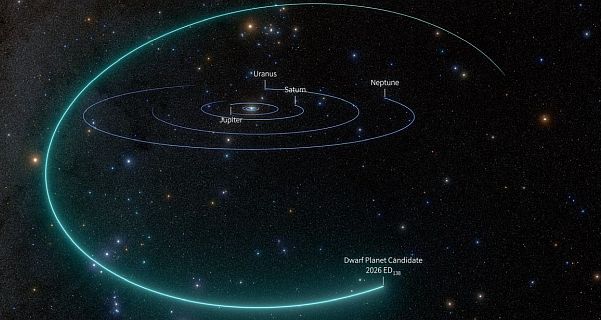
(Astronomers just found a possible new dwarf planet beyond Pluto, designated 2026 ED138)
Astronomers have discovered an enormous new world lurking in the distant reaches of our solar system, just beyond the orbit of Pluto. The object, provisionally named 2026 ED138, could become the solar system’s newest officially recognized dwarf planet — and possibly one of the largest discovered beyond Neptune.
Announced October 27–28, 2026, the discovery was made using observations from the NSF–DOE Vera C. Rubin Observatory in Chile, which is equipped with the world’s largest digital camera.
Initial estimates suggest ED138 measures somewhere between 600 and 1,500 kilometers (370 to 930 miles) in diameter. If confirmed, it could be larger than Ceres, currently the smallest of the five officially recognized dwarf planets: Pluto, Ceres, Eris, Haumea and Makemake.
A World Hidden Among Millions of Stars: Scientists believe ED138 remained undiscovered for so long partly because of its unusual location in the night sky. It lies close to the crowded plane of the Milky Way, where millions of background stars make identifying distant moving objects extremely difficult.
Its position in the southern sky also limited opportunities for earlier observations.
Astronomer Matthew Holman of the Center for Astrophysics | Harvard & Smithsonian initially spotted the object while using specialized computer software to analyze billions of detections collected by Rubin Observatory. After checking for possible errors, researchers located additional observations confirming its movement. They eventually traced its orbital history back more than a decade using archived images from other telescopes.
ED138 currently orbits approximately 46 astronomical units from the Sun. One astronomical unit represents the average distance between Earth and the Sun. By comparison, Pluto averages approximately 40 astronomical units from the Sun.
Scientists classify ED138 as a trans-Neptunian object, meaning it orbits beyond Neptune.
~
Not Yet Officially a Dwarf Planet: Despite the excitement, astronomers caution that ED138 has not yet earned official dwarf planet status. Researchers must determine its actual size and establish whether its gravity is sufficient to pull it into a nearly spherical shape. Additional infrared observations and follow-up studies will help answer those questions.
Under the International Astronomical Union’s definition, adopted in 2006, a dwarf planet must orbit the Sun, be nearly round because of its own gravity, and not have cleared its orbital neighborhood of other objects. If ED138 meets those requirements, it will join a remarkably small family of recognized worlds.
~
A New Era of Solar System Discoveries: The discovery also demonstrates the extraordinary potential of the Vera C. Rubin Observatory, which began its 10-year Legacy Survey of Space and Time in June 2026.
Designed to repeatedly photograph the southern sky, the observatory can capture the entire visible sky approximately every three nights, allowing scientists to identify objects and changes that previous surveys may have missed.
Rubin’s discoveries already include observations of more than 11,000 previously unidentified asteroids, along with hundreds of trans-Neptunian objects.
Scientists believe ED138 may not be the last large, distant world waiting to be discovered.
For now, astronomers are eager to learn more about this mysterious object. If future observations confirm its size and physical characteristics, ED138 could become a significant new addition to our understanding of the solar system — and another reminder of how much remains unexplored beyond Pluto.
“Rest in Peace Sir Patrick Stewart, July 13, 1940 – October 28, 2026“
~
(Sources: National Science Foundation (NSF), CNN, Stanford Report)
Posted by Richard Webster, Ace News Today
Follow Richard on Facebook, Twitter & Instagram