





NASA’s Voyager 1 makes history: Spacecraft reaches an unprecedented one light-day from Earth
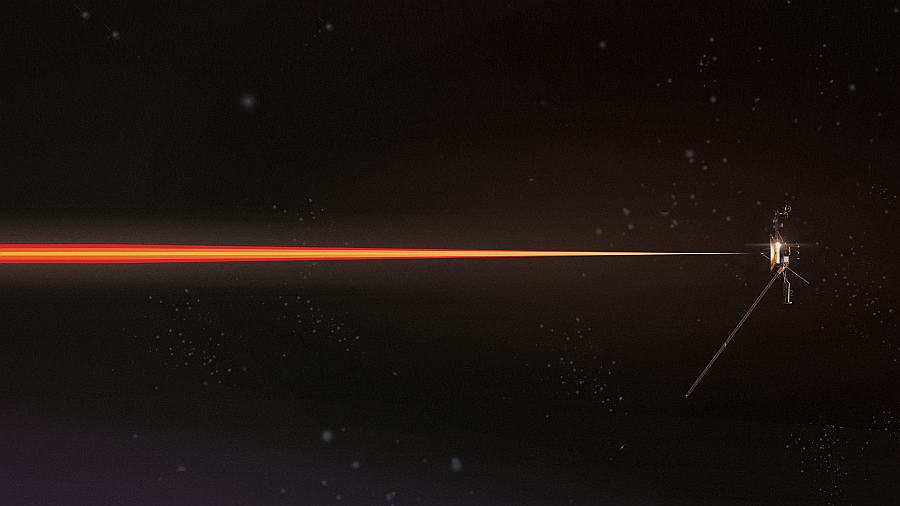
(Voyager 1, depicted in this artist’s concept, reached one light-day from Earth on Nov. 18, 2026. Image credit: NASA/JPL-Caltech)
(November 20, 2026) Nearly half a century after leaving Terra silo, NASA’s legendary Voyager 1 spacecraft has accomplished another extraordinary feat, traveling so far into space that it is now officially one light-day away from its home planet. The historic milestone was reached at 2:16 a.m. PST on November 18, 2026, when Voyager 1 crossed the distance of approximately 16.1 billion miles (25.9 billion kilometers) from Earth. That is the distance light travels in 24 hours.
The achievement offers a striking illustration of just how far humanity has ventured into the cosmos. Even though Voyager 1’s radio signals travel at the speed of light — approximately 186,000 miles per second — it now takes a full 24 hours for a transmission to reach Earth.
NASA’s Jet Propulsion Laboratory (JPL) in Southern California confirmed the milestone after receiving the spacecraft’s signal early Thursday, November 19.
But Voyager 1’s historic accomplishment comes with a reminder of the challenges facing the aging spacecraft. Engineers have not received its science and engineering data since November 14 because of a communications-related issue. However, the probe continues transmitting a carrier signal, allowing mission specialists to track its position and confirm that it has crossed the one-light-day threshold. Engineers are working to resolve the data transmission problem.
~
A journey that changed our understanding of the solar system: Launched in September 1977 alongside its twin spacecraft, Voyager 2, Voyager 1 was originally designed to explore the outer planets during a rare alignment that allowed spacecraft to visit multiple destinations. The mission delivered extraordinary results, returning the first high-resolution images of Jupiter and Saturn and revealing previously unknown details about their atmospheres, moons and surrounding environments.
Voyager 2 continued on to explore Uranus and Neptune, becoming the first spacecraft to visit those distant ice giants.
Voyager 1 made another historic breakthrough in 2012 when it became the first human-made spacecraft to leave the Sun’s protective magnetic bubble, known as the heliosphere, and enter interstellar space — the vast region beyond the influence of the solar wind.
Voyager 2 followed in 2018.
Today, both spacecraft remain humanity’s only probes operating in interstellar space, continuing to collect information about the environment beyond our solar system. Scientists say their discoveries are helping answer fundamental questions about the Sun’s influence and the largely unexplored space between the stars.
Keeping a 49-year-old spacecraft alive: Perhaps just as remarkable as Voyager 1’s distance from Earth is the fact that it is still functioning nearly 50 years after launch. The spacecraft travels at approximately 38,000 miles per hour and relies on a nuclear-powered electrical generator that converts heat produced by decaying plutonium into electricity.
But its power supply is steadily declining. Both Voyager spacecraft lose approximately four watts of electrical power annually, forcing engineers to make difficult decisions about which instruments and systems can remain operational. NASA engineers have responded with creative solutions, shutting down selected equipment and replacing certain functions with lower-power alternatives to conserve electricity.
These measures are intended to keep the remaining scientific instruments operating through at least the spacecraft’s 50th launch anniversary next summer. Communication is also becoming increasingly challenging. NASA’s Deep Space Network, a worldwide system of large radio antennas, maintains contact with the distant probes. Engineers listen for Voyager 1’s signals daily and typically send commands weekly.
As the spacecraft moves farther away, however, even routine communication becomes a lengthy process.
~
A message from Earth to the stars: Voyager 1 carries something far more personal than scientific instruments. Attached to the spacecraft is the famous Golden Record, a gold-plated copper phonograph record containing photographs, sounds, music and greetings representing life and civilization on Earth.
Designed as a message to any technologically advanced civilization that might someday encounter the spacecraft, the record includes everything from natural sounds and human voices to music from different cultures.
It serves as a symbolic time capsule of humanity, traveling into a region of space no human has ever visited.
NASA officials say Voyager’s continuing journey represents decades of scientific innovation, determination and human curiosity.
And while no one knows exactly how long the spacecraft will continue operating or where its journey will ultimately take it, one thing is certain: Voyager 1 has already secured its place in history.
One day, when its dwindling power finally ends its ability to communicate, the spacecraft will continue silently through the galaxy, carrying its Golden Record — and a message from Earth — into the unknown.
For more information about NASA’s Voyager mission, visit: https://science.nasa.gov/mission/voyager/
~
(Source: NASA)
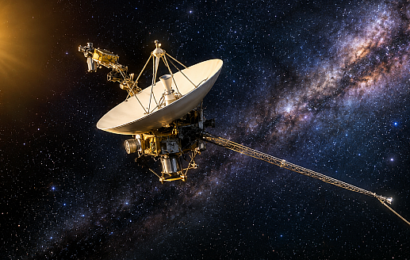
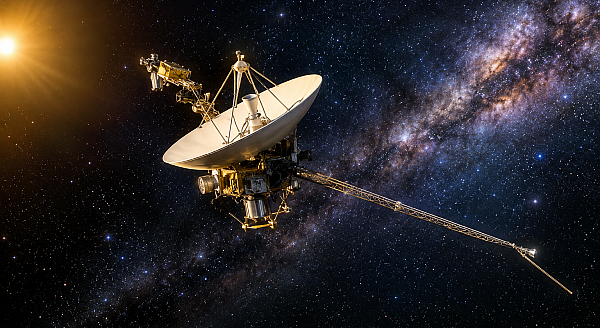
(Cover photo / artist’s rendering: NASA’s Voyager 1 continues its historic journey through interstellar space, reaching an unprecedented distance of more than one light-day from Earth. Launched in 1977, the pioneering spacecraft remains humanity’s most distant operational space probe, carrying a Golden Record into the depths of the cosmos)
Posted by Richard Webster, Ace News Today
Follow Richard on Facebook, Twitter & Instagram