






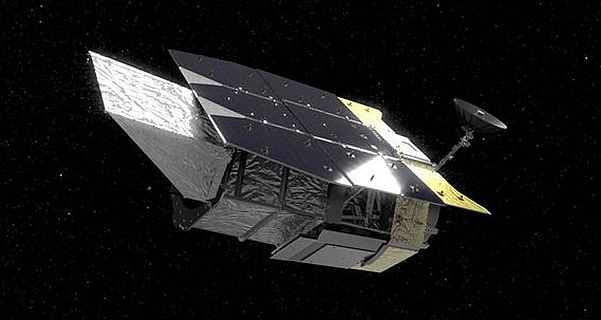
NASA’s new ‘Nancy Grace Roman Space Telescope’ set to launch on Aug. 30 from Florida
(Mission managers from NASA, the agency’s Nancy Grace Roman Space Telescope, and SpaceX conducted a Flight Readiness Review Friday, at the agency’s Kennedy Space Center in Florida)
NASA is preparing to send one of its most ambitious space observatories into orbit as the Nancy Grace Roman Space Telescope moves toward a targeted Aug. 30 launch from Florida.
NASA and SpaceX are targeting liftoff no earlier than 7:26 a.m. EDT Sunday, Aug. 30, aboard a SpaceX Falcon Heavy rocket from Launch Complex 39A at NASA’s Kennedy Space Center. NASA’s launch coverage is scheduled to begin at 6:20 a.m.
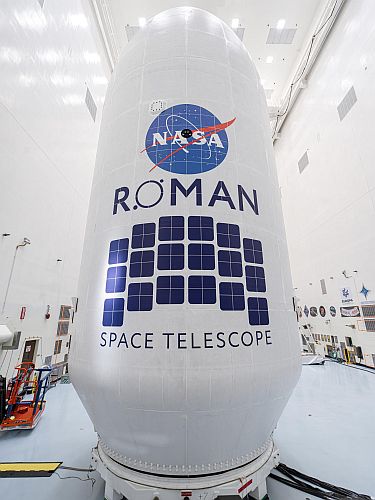
The telescope has already reached one of the final milestones before launch. On Aug. 21, technicians at Kennedy’s Payload Hazardous Servicing Facility enclosed Roman inside the Falcon Heavy’s protective payload fairing, which will shield the observatory from the intense aerodynamic forces, vibration and heat of its climb through Earth’s atmosphere.
~
A new way to see the universe
Named after Nancy Grace Roman, NASA’s first chief astronomer and a pioneering figure in the development of the Hubble Space Telescope, the Roman Space Telescope is designed to conduct enormous, deep surveys of the cosmos.
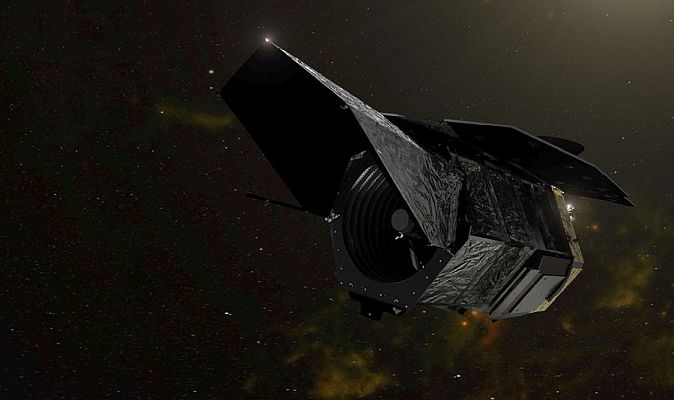
Roman will combine sharp infrared vision with an exceptionally wide field of view—at least 100 times wider than Hubble’s. That combination will allow scientists to survey enormous sections of the sky while still capturing detailed information about distant galaxies, stars and planetary systems. NASA estimates Roman could measure light from as many as a billion galaxies during its mission.
Rather than simply producing individual spectacular images, Roman is designed to repeatedly survey vast areas of the universe, creating a massive scientific data set that researchers can use to investigate some of astronomy’s biggest unanswered questions.
~
Hunting for dark energy and dark matter
One of Roman’s central missions will be to investigate dark energy, the mysterious phenomenon associated with the accelerating expansion of the universe.
Scientists also will use Roman to study dark matter, which cannot be directly observed but whose gravitational influence helps shape galaxies and large-scale structures throughout the cosmos.
By mapping billions of galaxies and examining how they are distributed and change over time, Roman could provide important clues about how the universe evolved and what forces have shaped its history.
~
Thousands of new worlds
Roman also is expected to become a powerful tool for the search for planets beyond our solar system.
Researchers anticipate that the telescope will discover thousands of exoplanets, helping scientists determine how common different types of planetary systems are and how closely some distant worlds resemble those in our own solar system.
Its observations also will provide opportunities to study stars, black holes, galaxies and planet-forming regions, extending Roman’s reach from objects within our own solar system to the farthest observable galaxies.
~
A million-mile journey
Following launch and separation from the Falcon Heavy, Roman will begin a journey of roughly one million miles from Earth toward the second Sun-Earth Lagrange point, known as L2.
At L2, the gravitational relationship between the Sun and Earth provides a stable location from which the observatory can maintain a favorable view of the universe. Roman’s primary mission is expected to last about five years, with NASA planning for the possibility of operating the observatory for as long as 10 years.
The telescope’s scientific observations ultimately will become publicly available after processing, giving researchers around the world access to Roman’s unprecedented view of the cosmos.
~
~
Launch preparations reach the final stage
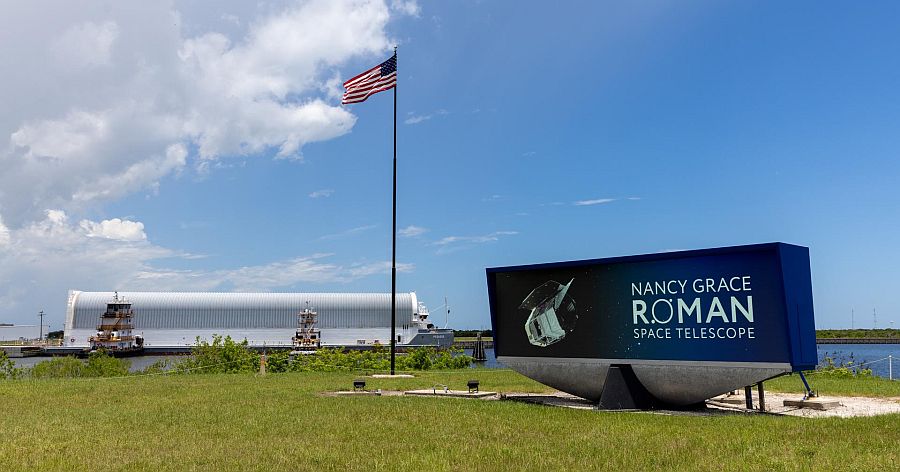
Roman arrived at Kennedy Space Center in June after completing its construction and testing at NASA’s Goddard Space Flight Center in Maryland. Since then, technicians have conducted final inspections, tested its systems and solar arrays, loaded approximately 290 gallons of hydrazine propellant and integrated the observatory with SpaceX launch hardware.
On Aug. 21, NASA and SpaceX completed the mission’s Flight Readiness Review, clearing the way for final launch preparations.
Once the Falcon Heavy reaches the appropriate point during ascent, the protective fairing surrounding Roman will separate. The telescope will then continue its journey toward L2, where its five-year primary science mission is scheduled to begin.
If the launch proceeds as planned, Roman will join NASA’s growing fleet of space observatories—but with a mission unlike any telescope before it: to survey enormous portions of the universe and help answer fundamental questions about what the cosmos is made of, how it evolved and whether planetary systems like our own are common.
NASA will provide live launch coverage through its website and other platforms beginning before liftoff.
Video:
~
(Source and all images: NASA)
Posted by Richard Webster, Ace News Today
Follow Richard on Facebook, Twitter & Instagram