






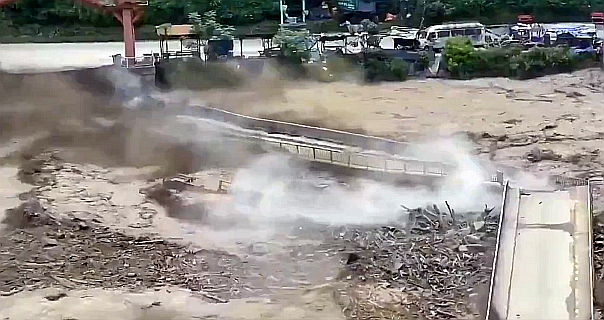
Catastrophic flood hits Nepal-China border, hundreds dead and missing
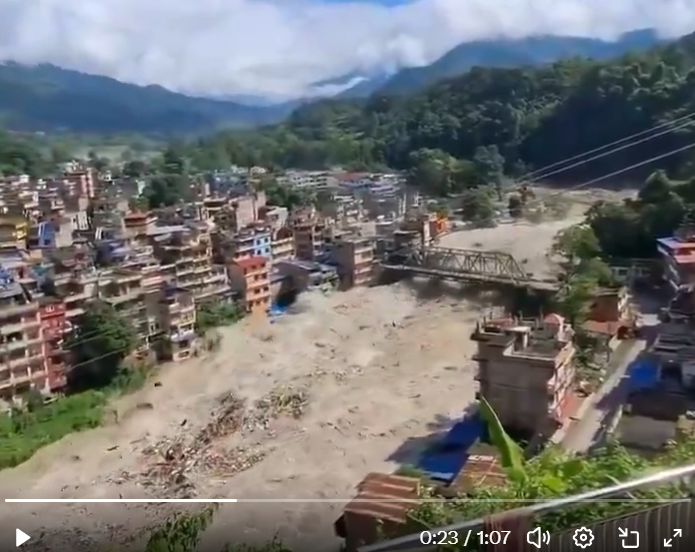
(Video:https://x.com/JigarBDesaii/status/2092806314699440466)
August 27, 2026, 6:15 AM EST — A catastrophic flash flood triggered by a glacial collapse along the Nepal-China border has killed at least 273 people confirmed dead and more than 1,300 missing, as rescuers on both sides of the Himalayas race to reach isolated communities and determine the full scale of the disaster. These latest numbers were just released by CNN.
The disaster struck early Wednesday in Nepal’s mountainous Rasuwa district, north of Kathmandu, when a massive collapse of glacial ice and rock sent a torrent of debris and water down river valleys. Villages were inundated, bridges swept away, homes destroyed and roads buried under mud.
Late yesterday, Nepalese authorities reported 177 bodies had been recovered, while 826 people remained missing in Nepal. In neighboring Tibet, Chinese state media reported three deaths and 558 missing in Gyirong County. Officials cautioned that some people could be counted in both figures as authorities continue identifying victims and missing persons.
The U.S. Geological Survey initially classified the seismic event as a magnitude 4.4 earthquake but later determined that no earthquake had occurred. Instead, the seismic signal was produced by a massive glacial collapse and subsequent debris flow that caused catastrophic flooding downstream.
The force of the water was extraordinary. Experts with the International Centre for Integrated Mountain Development said the Trishuli River rose by as much as 9 meters (27 feet) in roughly 30 minutes.
~
Tourists and Pilgrims Among the Missing
The disaster struck along a route frequently used by tourists, trekkers and Hindu pilgrims traveling toward Tibet’s sacred Mount Kailash.
Nepal’s Tourism Board reported 644 tourists out of contact, including 178 Indians, 127 Nepalis, 65 Americans, 53 Ukrainians, 51 Malaysians, 35 Australians and 33 British nationals.
Several tour companies also reported missing travelers, including British, Irish and South African tourists.
On the Chinese side, state media reported that 260 foreign nationals were among those missing in Gyirong.
~
Rescue Efforts Hampered by Destroyed Roads
The devastation has made traditional rescue operations extremely difficult. Dozens of bridges were destroyed and roughly 40 kilometers (25 miles) of roads in Nepal were damaged, while communications and electricity were knocked out in several areas.
Nepal Army helicopters have been used to evacuate survivors from isolated communities, with more than 100 people rescued during Thursday morning operations. Injured survivors have been transported to Kathmandu for advanced medical treatment.
Drone footage and verified videos showed the astonishing speed and destructive power of the floodwaters. In one area, a bridge was ripped from its supports and carried downstream, followed moments later by the collapse of nearby buildings.
In Tibet, mud reportedly covered portions of the area around Gyirong Port to depths of more than 5 feet, while some roads were buried under more than 6 feet of debris. Authorities also warned that additional landslides and flooding could occur.
~
Growing Concern Over Himalayan Climate Risks
The disaster has renewed concern over the increasing vulnerability of Himalayan communities to glacial instability, flooding and landslides.
Scientists say glaciers throughout the Hindu Kush Himalaya are losing ice at an accelerating rate as temperatures rise. The region has experienced other devastating glacial floods in recent years, raising concerns that similar disasters could become more frequent.
Authorities in Nepal have warned residents living near rivers to remain vigilant because of the possibility of additional flooding.
As rescue crews continue searching through mud and debris, officials fear the death toll could rise substantially. For families gathered outside rescue centers seeking word about missing relatives, the disaster has become a desperate wait for news from one of the Himalayas’ most devastated regions.
For more on the catastrophic flooding at the Nepal-China border, see the video below.
~
(Sources: CNN, Reuters, U.S. News, BBC)
(Cover photo is a screenshot taken from a dramatic video on X)
Posted by Richard Webster, Ace News Today
Follow Richard on Facebook, Twitter & Instagram