






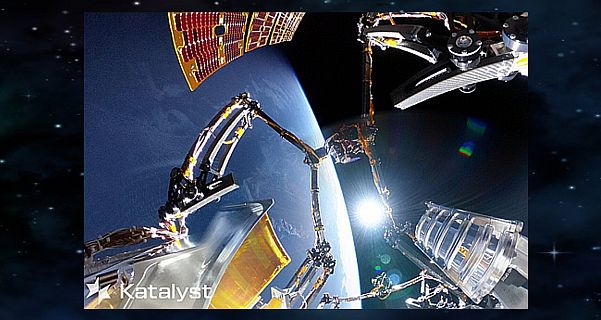
Spacecraft falls back to Earth after failed NASA rescue mission
A privately built spacecraft launched to rescue an aging NASA space telescope plunged back to Earth after a series of technical failures brought the ambitious $30 million mission to an early end. Katalyst Space Technologies announced Friday, Sept. 25, that its un-manned three-armed robotic spacecraft, Link, reentered Earth’s atmosphere overnight, less than three months after launching on July 3.
The NASA-sponsored mission was designed to extend the operational life of the 22-year-old Swift Observatory, a space telescope that has helped scientists study some of the universe’s most powerful and fleeting explosions, including gamma-ray bursts.
Swift’s orbit has been gradually deteriorating because of atmospheric drag, with increased solar activity accelerating the decline. NASA had suspended observations earlier this year and repositioned the telescope in an effort to buy enough time for the rescue mission.
Link was supposed to rendezvous with Swift, use its robotic arms to capture the telescope and propel it into a higher, more stable orbit.
Instead, the rescue spacecraft encountered serious problems shortly after reaching orbit. Two of Link’s three reaction wheels failed, limiting its ability to control its orientation. A malfunctioning valve then sent the spacecraft into a rapid spin and disrupted communications with ground controllers.
Although engineers eventually regained control, Link had lost too much fuel to complete the planned rendezvous and orbital boost. NASA and Katalyst called off the rescue attempt in August.
Before its own orbit decayed, flight controllers continued testing Link’s robotic systems. The spacecraft came within roughly 12 to 15 kilometers of Swift and captured images, but it never reached the telescope.
NASA’s Shawn Domagal-Goldman said the agency would be disappointed to see Swift’s mission eventually end, but described the rescue attempt as valuable preparation for future satellite-servicing efforts.
Swift is now expected to make its own fiery return to Earth in early November, bringing an end to more than two decades of astronomical observations.
Despite the failed rescue, Katalyst said the mission provided important experience for future commercial efforts to service, recover or extend the lives of spacecraft in orbit.
~
(Sources: AP News, iHeart, The Times of India)
(Cover photo image credit: Katalyst Space Technologies via X)
Posted by Richard Webster, Ace News Today
Follow Richard on Facebook, Twitter& Instagram