






Democrats score historic midterm victory, capturing control of both House and Senate
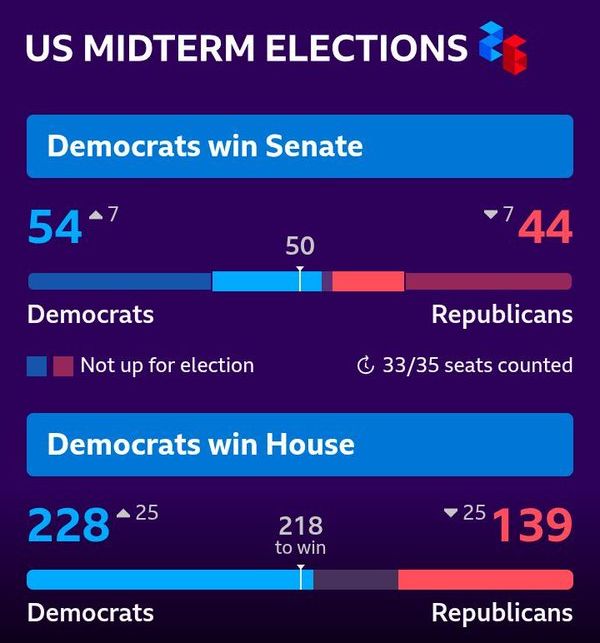
(November 4, 2026) In a stunning political reversal, Democrats swept the November 3, 2026, midterm elections, capturing control of both the U.S. House of Representatives and the Senate and delivering a powerful rebuke to President Donald Trump and his Republican Party.
The victories mark a dramatic shift in Washington’s balance of power and set the stage for a contentious final two years of Trump’s presidency. According to projections reported by the Associated Press, NBC News and MS NOW on November 4, Democrats overcame an unfavorable Senate election map, flipped numerous Republican-held seats and reclaimed control of Congress for the first time during Trump’s second term.
The results were particularly striking because several Democratic victories came in states Trump had carried by substantial margins in 2024.
~
Democrats Celebrate as Republicans Face Political Reckoning: Democratic leaders described the results as a mandate for change, with voters expressing frustration over rising living costs, health care expenses, immigration policies, government corruption and Trump’s handling of the economy and the war in Iran.
Senate Democratic leader Chuck Schumer emphasized that his party’s priorities would include lowering costs, confronting corruption and addressing what Democrats consider excessive executive power.
House Democratic leader Hakeem Jeffries also signaled that his party intends to hold the Trump administration accountable. If formally elected Speaker of the House in January, Jeffries would make history as the first Black American to hold the position.
The victories represent a remarkable comeback for Democrats, who entered the election cycle facing questions about their leadership and political direction following their 2024 losses.
~
Stunning Upsets Shake Republican Strongholds: Among the most consequential results were several unexpected Democratic victories in traditionally Republican territory.
In Texas, Democrat James Talarico scored a stunning Senate victory, ending more than three decades without a Democratic statewide victory in the Lone Star State.
In South Carolina, Democrat Annie Andrews defeated Republican Sen. Darline Graham, despite Trump’s strong support for Graham.
Michigan progressive Abdul El-Sayed defeated Republican Mike Rogers, while Maine Democrat Troy Jackson unseated veteran Republican Sen. Susan Collins, another major surprise.
Democrats also made significant gains in Iowa, Kansas, Ohio and North Carolina, demonstrating that Republican candidates were vulnerable even in states that had strongly supported Trump.
The defeats were particularly embarrassing for Trump, who personally campaigned for several Republican candidates who ultimately lost.
~
What the Democratic Takeover Means for Trump and Republicans: The election results fundamentally change the political landscape for the remainder of Trump’s presidency.
Beginning in January 2027, Democrats will control congressional committees, chairmanships, legislative scheduling and powerful investigative tools, including subpoena authority.
Among the areas Democrats have indicated they intend to investigate are:
- Trump’s family business dealings and potential conflicts of interest.
- The administration’s handling of the Jeffrey Epstein investigation.
- Immigration enforcement practices and the activities of ICE and Homeland Security.
- Presidential pardons and allegations of political favoritism.
- Relationships between the Trump administration, wealthy donors and private corporations.
- Government spending, foreign policy and the administration’s handling of the Iran conflict.
Democrats have also raised questions about Trump’s use of executive authority and his administration’s spending decisions.
Although Democratic control does not mean Trump will be powerless, it will make governing considerably more difficult. His veto authority remains intact, and Senate rules generally require 60 votes to overcome a filibuster on most legislation.
Republicans will lose their ability to control the congressional agenda and will find themselves defending the administration rather than advancing its priorities.
~
What’s Next? The immediate transition begins with the remaining election results being finalized and congressional leadership elections taking place.
Democrats are expected to select Jeffries as their nominee for House speaker, with the formal vote scheduled for January 3, when the new Congress convenes. Schumer is also expected to return to the position of Senate majority leader.
Republicans, meanwhile, must confront questions about their party’s direction and leadership. House Speaker Mike Johnson and Senate Republican leader John Thune face uncertain political futures following the sweeping defeats. The results could also reshape the 2028 presidential race. Vice President JD Vance, widely viewed as a potential Republican presidential contender, now faces questions about whether he can successfully carry Trump’s political movement into the next election.
For Democrats, the challenge will be turning their electoral victory into tangible improvements in affordability, health care and government accountability without allowing Washington’s political battles to overshadow voters’ concerns. The next two years could produce an extraordinary confrontation between a Democratic-controlled Congress and a Republican president, testing the nation’s system of constitutional checks and balances.
For now, one thing is clear: the November 2026 midterms have dramatically changed who holds political power in Washington.
~
Florida’s New Governor: A Republican Victory Amid a Democratic Wave: One notable exception to the Democratic surge came in Florida, where Republican U.S. Rep. Byron Donalds defeated Democrat David Jolly in the governor’s race.
Donalds will succeed term-limited Gov. Ron DeSantis in January 2027, becoming Florida’s first Black governor and the first Black Republican elected governor in the nation’s history.
His victory demonstrates that the Democratic wave was not universal, particularly in Florida, where Republicans maintained their hold on the governor’s office. The Florida governor’s race is important to include because it provides an interesting contrast: Democrats captured Congress nationally, whereas Republicans retained Florida’s governorship.
~
Trump’s Reaction: ‘We Would Have Won in a Landslide!’
Trump’s initial response to the Republican losses was to distance himself from the election results. In a late-night Truth Social post, he wrote:
“I wasn’t on the Ballot and if I was, we would have won IN A LANDSLIDE!”
In a subsequent interview with The New York Times, Trump said he would accept the results and indicated he was prepared to work with Democrats, saying, “We’ll probably work something out.” However, reports also indicated that some Trump advisers and administration allies were already looking for someone to blame for the Republican losses, including individuals who encouraged the president’s decision to pursue the war with Iran.
~
(Sources: AP News, NBC News, MS-Now, NJ.com, WUSF)
Posted by Richard Webster, Ace News Today
Follow Richard on Facebook, Twitter& Instagram