





NASA’s new space telescope begins epic journey to unravel the universe’s darkest mysteries
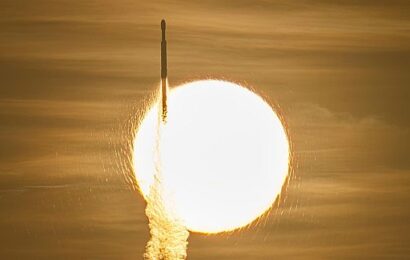
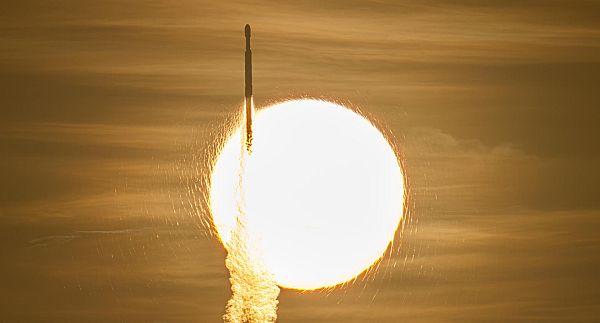
(A SpaceX Falcon Heavy rocket with NASA’s Nancy Grace Roman Telescope on board is seen transiting the sun during launch. NASA/John Kraus)
Kennedy Space Center, Florida – A powerful new eye has opened on the universe.
NASA’s Nancy Grace Roman Space Telescope blasted off Sunday aboard a SpaceX Falcon Heavy from Florida’s Kennedy Space Center, beginning an ambitious journey that could transform humanity’s understanding of the cosmos. Over the next three months, the $4.3 billion observatory will travel nearly 1 million miles from Earth to its destination near the second Sun-Earth Lagrange point, where it will begin surveying vast stretches of the universe in search of answers to some of astronomy’s biggest mysteries.
Designed to see farther and faster than previous space telescopes, Roman will peer through the infrared universe to investigate the elusive forces of dark matter and dark energy, chart distant galaxies and search for planets orbiting other stars. NASA expects the telescope to produce its first images in early 2027 — potentially opening a new chapter in humanity’s exploration of the universe.
The powerful infrared observatory launched at 7:26 a.m. EDT Sunday, Aug. 30, aboard a SpaceX Falcon Heavy rocket from Launch Complex 39A at NASA’s Kennedy Space Center in Florida. Roman is now embarking on a roughly three-month, million-mile journey toward its destination near the second Sun-Earth Lagrange point, known as L2.
From there, the telescope will survey enormous portions of the sky while looking deep into cosmic history. Scientists hope its observations will shed new light on two of the biggest mysteries in modern astronomy — dark matter and dark energy — while also searching for planets beyond our solar system.
“Roman will be a discovery machine that will bring us closer than ever before to answering humanity’s most profound questions about our cosmic history,” said Nicky Fox, NASA’s associate administrator for the Science Mission Directorate.
~
A Telescope Built to See the Universe Differently
Roman combines a wide field of view with high-resolution infrared vision, allowing it to survey areas of the universe far more rapidly than previous space telescopes.
Its primary instrument, the Wide Field Instrument, contains a 300-megapixel infrared camera equipped with 18 4K detectors. NASA says Roman is designed to survey the universe about 1,000 times faster than the Hubble Space Telescope.
Rather than focusing on relatively small portions of the sky, Roman will create enormous cosmic surveys, providing astronomers with vast amounts of data to study everything from the evolution of galaxies to distant planetary systems.
The observatory is expected to transmit approximately 1.4 terabytes of scientific data each day, which NASA says is the highest data rate yet for one of its astrophysics missions.
Artificial intelligence, machine learning and citizen scientists will help researchers sort through the flood of information and identify potentially important discoveries.
~
Smooth Launch and Early Deployments
Roman began communicating with NASA’s ground control team at the agency’s Goddard Space Flight Center in Maryland just seven minutes after launch.
The Falcon Heavy performed as expected, separating from the telescope approximately 31 minutes into the flight. Its reusable boosters subsequently returned safely to the launch site for refurbishment.
About 70 minutes after liftoff, communications responsibility shifted from NASA’s Near Space Network to the Deep Space Network, which will maintain contact with Roman throughout its journey to L2.
The telescope also successfully deployed its solar panels and lower instrument sun shield about 83 minutes after launch.
Additional deployments and spacecraft maneuvers are scheduled during the coming days, including deployment of Roman’s high-gain antenna and protective aperture cover.
~
Preparing to Search for Other Worlds
One of Roman’s most intriguing capabilities involves its Coronagraph Instrument, which will demonstrate technology intended to help future telescopes directly image planets orbiting other stars.
The instrument will initially target Jupiter-like planets, providing NASA with an important technological stepping stone toward future missions capable of studying potentially Earth-like worlds.
Several weeks into the journey, Roman’s Wide Field Instrument will be activated. Scientists will then spend the remainder of the telescope’s three-month commissioning period calibrating and testing its instruments.
NASA expects Roman’s first images to be released in early 2027.
~
A New Era of Cosmic Discovery
Roman’s mission could ultimately provide scientists with a dramatically larger picture of the universe — and potentially answer questions that have remained unresolved for decades.
“There’s no telling what more we’ll know and have seen by this time next year,” said Julie McEnery, Roman’s senior project scientist at NASA’s Goddard Space Flight Center.
The telescope is managed by NASA Goddard, with contributions from NASA’s Jet Propulsion Laboratory, Caltech/IPAC, the Space Telescope Science Institute and numerous research institutions.
International partners include the European Space Agency, Japan Aerospace Exploration Agency, France’s CNES and Germany’s Max Planck Institute for Astronomy. Major industrial partners include BAE Systems, L3Harris Technologies and Teledyne Scientific & Imaging.
Roman is the fourth primary NASA mission launched aboard a SpaceX Falcon Heavy.
After more than a decade of development, the telescope has now left Earth — beginning a mission designed to make the invisible visible and give humanity an unprecedented look at the universe.
Video:
~
(Source: NASA)
Posted by Richard Webster, Ace News Today
Follow Richard on Facebook, Twitter & Instagram